
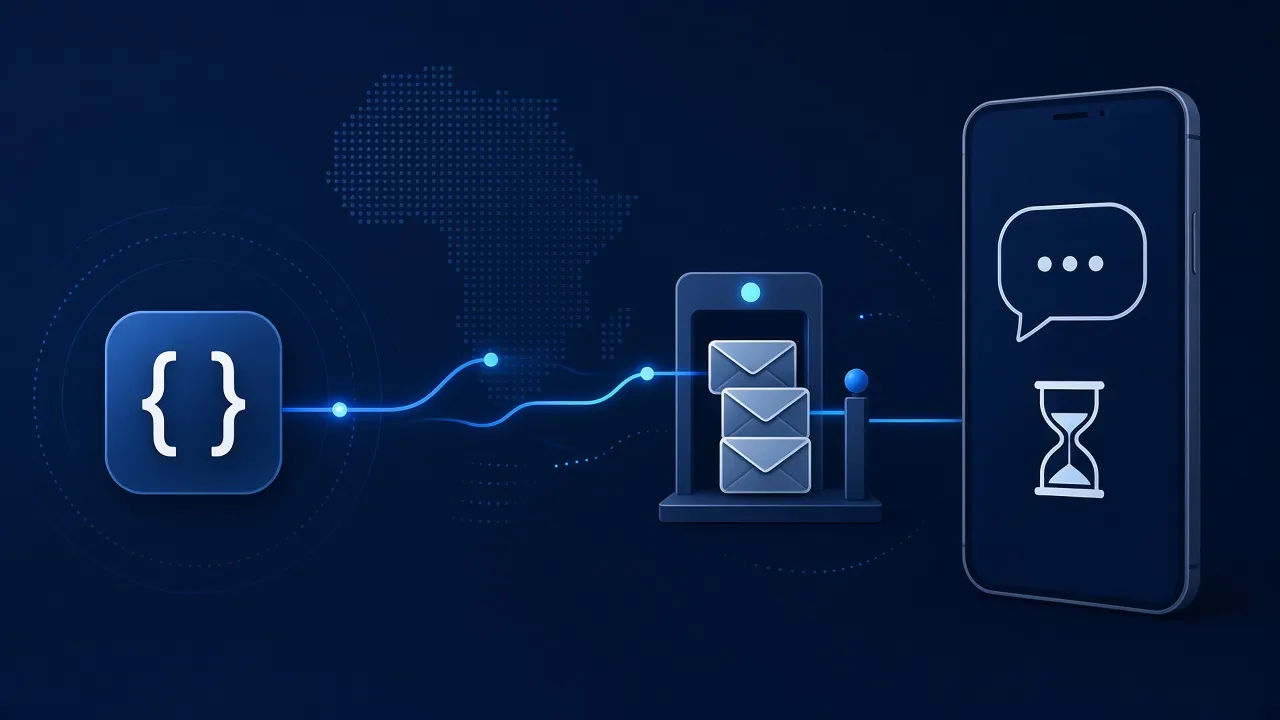
You send an SMS from your application. The API responds quickly. The request is accepted. Yet your user is still waiting for the message.
A few seconds pass. Then a minute. Sometimes longer.
For a marketing message, this may be inconvenient. For a transactional SMS or OTP, it can become a serious problem: the user assumes the code is not working, requests another one or abandons the process entirely.
The important point is this: the API is only one step in the SMS delivery journey.
1. The API is not the phone
When an application sends an SMS, several steps take place:
Your application → SMS API → routing platform → mobile operator → network → recipient’s phone
When your API returns 200 OK, it generally means that your request has been accepted by the platform.
It does not necessarily mean that the phone has already received the message.
This distinction is fundamental when analysing SMS performance.
2. Routing can make a major difference
A destination can sometimes be reached through several possible routes.
One route may have strong connectivity with the relevant operator. Another may involve more intermediaries.
The more complex the delivery path, the more opportunities there are for queuing, delays or rejection.
This matters particularly in Africa, where routing conditions vary significantly from one market to another.
There is no single “Africa route”.
A route that performs well in Benin is not necessarily the best route for Togo, Burkina Faso, Cameroon or another market.
3. The mobile network can also introduce delays
Even after the message has successfully left the SMS platform, the mobile network can encounter different situations:
- the phone is temporarily out of coverage;
- weak network availability;
- the handset is switched off;
- temporary congestion;
- operator-side queuing;
- routing or interconnection issues.
In some cases, the SMS has not been lost. It is simply waiting for delivery.
That is one reason a message can arrive significantly later than expected.
4. “Sent” is not the same as “Delivered”
This is a common mistake when integrating an SMS API.
At a minimum, systems should distinguish between:
- Accepted / Sent: the platform accepted or transmitted the message.
- Delivered: a delivery receipt indicates that the message reached a defined delivery point.
- Failed / Undelivered: the delivery did not succeed.
The exact meaning depends on the operator and route.
That is why Delivery Reports (DLRs) are essential for critical messaging.
5. OTPs are especially sensitive to delays
The problem becomes even more visible with OTPs.
Consider this scenario:
- the user requests a code;
- the SMS is delayed;
- the user clicks “Resend”;
- a second OTP is generated;
- the first OTP finally arrives;
- the user enters the wrong code.
The problem appears to be authentication.
In reality, it may be a problem of SMS latency and OTP lifecycle management.
6. Measure the journey, not just the API
A good analysis should therefore go beyond HTTP response time.
You should look at:
- API response time;
- time before message processing;
- route used;
- delivery status;
- time between submission and DLR;
- performance by operator;
- performance by country;
- recurring error patterns.
This makes it possible to distinguish an application problem from a messaging problem.
7. Price does not tell the whole story
Two providers may offer different prices for the same destination.
But comparing only the price per SMS does not measure the real cost.
If a cheaper route generates more delays, failures or OTP retries, its effective cost may ultimately be higher.
For transactional messaging, predictable delivery is often more valuable than saving a small amount on the unit price.
Conclusion
An SMS does not travel directly from your API to the phone.
It passes through a technical chain involving your application, the SMS platform, routing, mobile operators and the network.
Understanding that chain makes delivery problems much easier to diagnose.
And when a user says:
“I didn’t receive my SMS.”
the right question is not simply “Is the API working?”
It is:
“Where did the message stop in its journey?”