
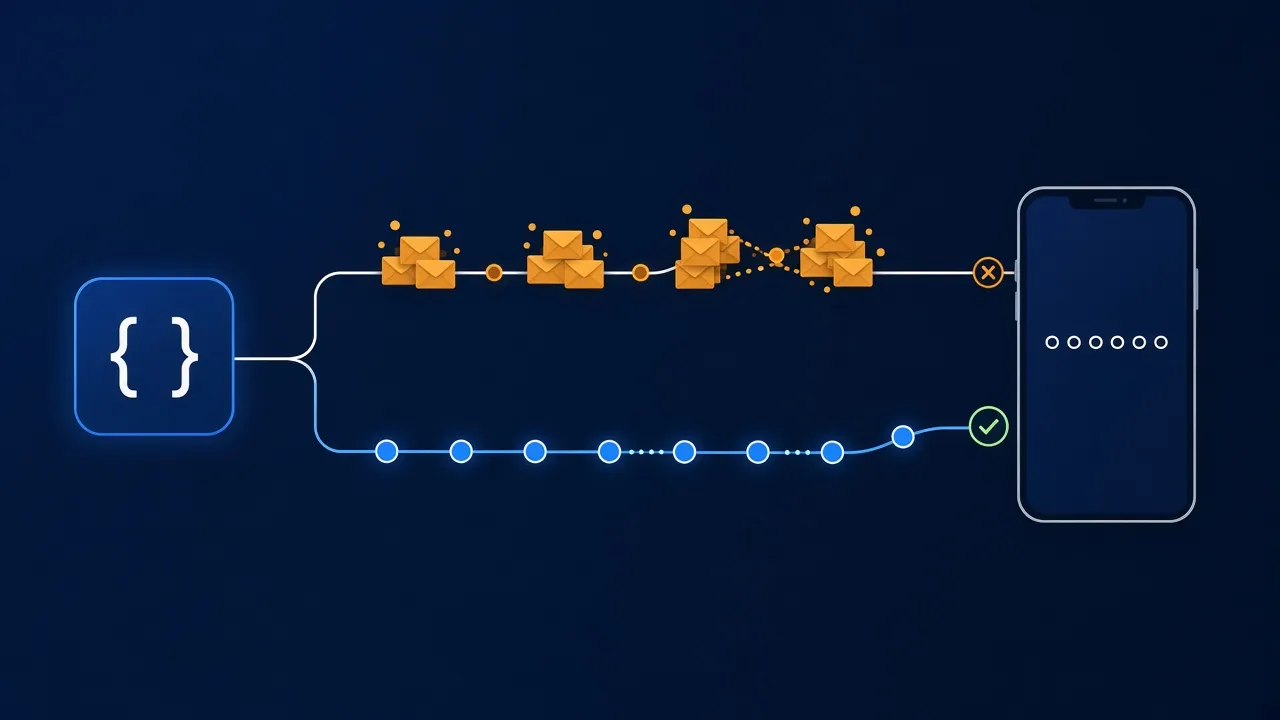
When businesses compare SMS providers, the first question is often:
What is the price per SMS?
For high-volume marketing traffic, this is obviously important.
But for OTPs?
The answer is more complicated.
An OTP only has value if it reaches the right user at the right time.
A cheaper SMS that is regularly delayed or undelivered may ultimately cost the business much more.
The real cost of an OTP is not its unit price
Consider a simple user journey.
A user is creating an account.
Your application generates an OTP and sends the SMS.
If the message arrives immediately, everything works.
But if delivery is delayed:
- the user waits;
- they request another code;
- a second message is generated;
- they may abandon the process;
- your system processes additional requests;
- your support team may receive complaints.
The real cost therefore goes beyond the SMS price.
A cheaper route may be cheaper for perfectly valid reasons
A low-cost route is not automatically a bad route.
A lower price may simply reflect scale, commercial agreements or a different cost structure.
The problem starts when a route is selected only because it is cheaper, without measuring its actual performance.
The better question is:
How much does a successfully delivered OTP really cost me?
Price per SMS does not measure quality
When comparing routes, look at several dimensions:
- delivery rate;
- delivery latency;
- stability;
- performance by operator;
- failure rate;
- DLR quality;
- scalability;
- peak-time behaviour.
A route may perform very well for one operator and less well for another.
It may also perform well at low volume and become less predictable as traffic increases.
OTP traffic has different requirements
A marketing SMS arriving several minutes late may be inconvenient but not critical.
An OTP is different.
The user is usually waiting for the code while actively completing a form.
The acceptable delay is therefore much lower.
That is why routing decisions should consider the type of traffic.
A route used for promotional campaigns is not necessarily the route you want for:
- authentication;
- payments;
- password resets;
- transaction verification.
Measure the cost per successful OTP
This is one of the most useful ways to think about routing.
Instead of comparing only:
€0.010 / SMS vs €0.012 / SMS
also look at:
total cost / successfully delivered and usable OTP
This changes the comparison completely.
If the cheaper route requires more retries, generates more failures or causes more user drop-off, the initial saving can disappear quickly.
Look at operator-level performance
A national average can hide important differences.
Your traffic may be distributed across several operators.
A route may perform extremely well on one network and less well on another.
If your provider only shows you an overall average, you may miss the real problem.
For critical applications, performance should ideally be analysed by:
country → operator → route → status → latency
What happens when the primary route fails?
The cost question becomes even more important when a route experiences an incident.
A serious OTP infrastructure should have a strategy for such situations.
Depending on the market and traffic volume, this may include:
- an alternative route;
- a backup provider;
- failover rules;
- delivery monitoring;
- anomaly alerts.
The objective is not to pay several providers unnecessarily.
It is to reduce the risk that a routing problem blocks user authentication.
Should you avoid cheap routes?
No.
You should simply avoid choosing them only because they are cheap.
A good route provides the right balance between:
price + delivery + latency + stability + coverage + support.
So the question is not:
“What is the cheapest route?”
It is:
“Which route can deliver my OTPs reliably enough at the best real cost?”
That distinction matters.
Because when it comes to OTPs, what you are really buying is not an SMS.
You are buying a successful delivery.