
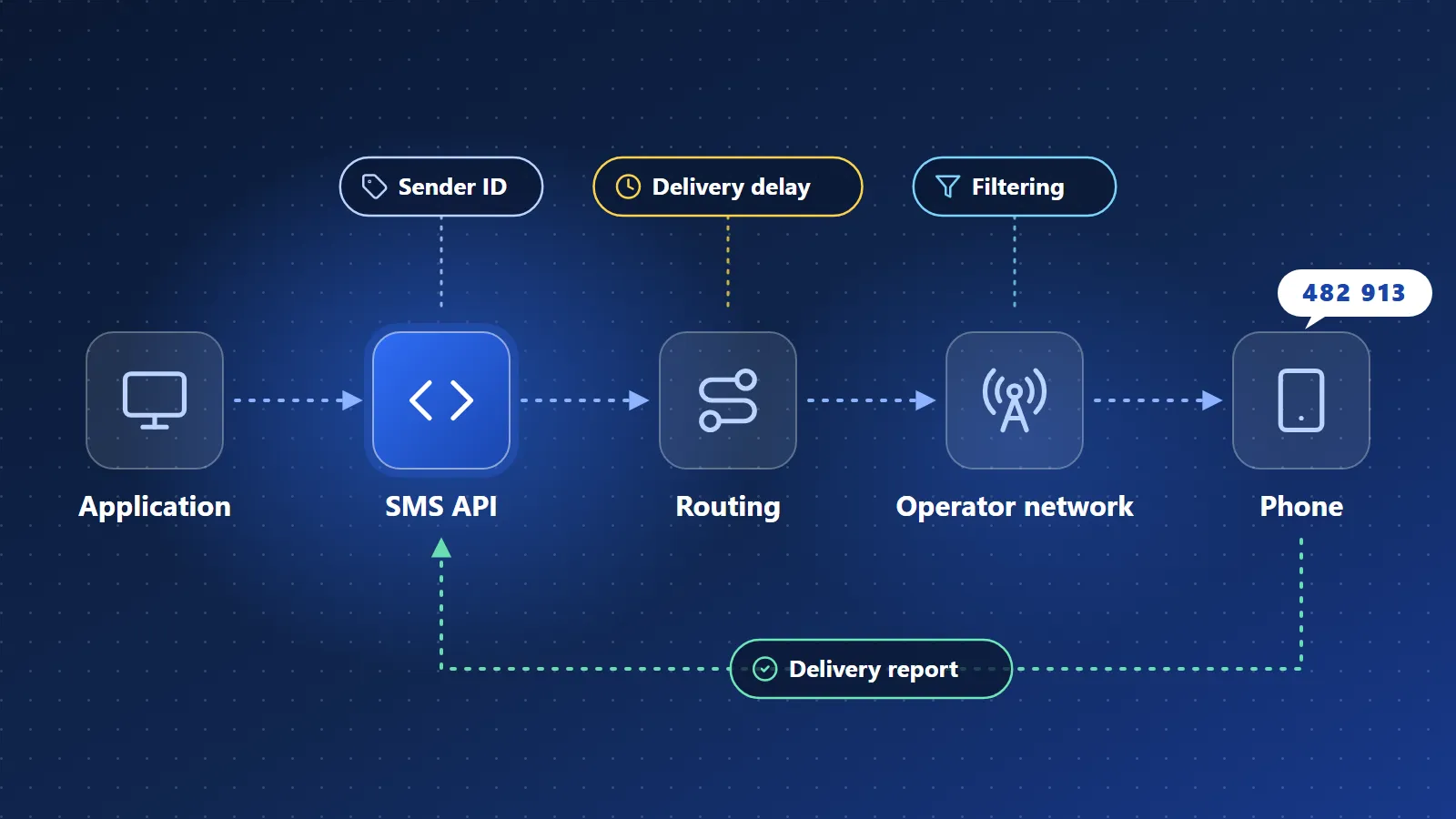
A user requests a verification code. The application generates the OTP correctly. The request is sent to the SMS API. The message is accepted.
But the user never receives it.
Or the code arrives several minutes later, after the user has already requested another one.
For a bank, fintech, payment platform, application or betting service, this can quickly become a business problem: users cannot log in, transactions are abandoned, registrations are interrupted, and customers may simply give up.
The first reaction is often to look at the application code or the API.
But the problem may be somewhere else.
Between the application generating the OTP and the phone receiving it, several steps are involved. And across African markets, those steps can vary depending on the country, mobile operator and type of traffic.
An OTP is not simply “sent”
When an application generates an OTP, it typically sends the message to an SMS platform through an API.
But the API is only the beginning of the journey.
The message then needs to be routed to the recipient’s mobile network, processed by the operator’s SMS infrastructure and delivered to the handset.
The journey can be simplified as:
Application → SMS API → Routing → Mobile Network → Phone
At each stage, something can delay, filter or prevent delivery.
This is why two businesses using similar SMS APIs can experience very different results depending on the countries and operators they are sending OTPs to.
1. Routing quality can make a major difference
This is probably one of the least visible factors for a business using an SMS API.
When an application sends an SMS, it usually does not choose the exact path the message will take to reach the recipient.
That path depends on the SMS provider’s infrastructure and its connections to mobile networks.
Depending on the country and operator, a message may travel through different routes. Some may be direct, while others involve several intermediaries.
Routes do not necessarily deliver the same level of reliability, speed or stability.
For a marketing SMS, a few extra seconds may not matter much.
For an OTP, it is different.
If the code arrives after it has expired, the message may technically have been delivered, but it is no longer useful to the user.
2. A problem may affect only one operator
This is another reason why global delivery statistics can be misleading.
A platform may send OTPs across several countries and networks while maintaining an excellent overall delivery rate.
But if OTP traffic to one particular operator regularly encounters problems, the global average may not reveal it.
The company may therefore see:
“Our delivery rate is excellent.”
while some users continue to say:
“I never receive my code.”
Both statements can be true.
The problem may be concentrated on one country, one operator or one route.
To understand what is really happening, performance should therefore be analysed at least by:
- country;
- operator;
- traffic type;
- Sender ID;
- time period;
- and, where available, the route used.
A global delivery rate does not tell the whole story.
3. Sender ID can affect delivery
Sender ID is often seen simply as the name displayed on the recipient’s phone.
But depending on the market, the applicable rules can be more complex.
Some countries or operators require registration or validation procedures. Sender IDs may also be subject to specific rules or filtering mechanisms.
And those rules are not the same across African markets.
This matters for businesses deploying the same OTP system across multiple countries.
A configuration that works in one country should not automatically be assumed to work everywhere.
Before sending significant traffic, it is therefore worth checking the requirements that apply to the target country and networks.
4. Message content can also be subject to filtering
Mobile networks process large volumes of SMS traffic and have to deal with spam, fraud and abusive use cases.
Filtering mechanisms can therefore be part of the message delivery process.
For OTP traffic, the message should be clearly identifiable as transactional communication.
A simple message such as:
Your verification code is 482913.
obviously has a different profile from a message containing several links, promotional content or other elements that may trigger filtering mechanisms.
This does not mean that a particular message will automatically be blocked.
It simply means that message content is one of the factors worth considering when investigating delivery problems.
5. The problem may also be the recipient number
Not every delivery failure should automatically be blamed on the SMS provider.
A number may be:
- incorrectly entered;
- incorrectly formatted;
- inactive;
- temporarily unavailable.
The recipient’s phone may also be temporarily out of network coverage or experiencing a reception problem.
Before investigating SMS routing, it is therefore worth checking the basics:
Is the number correct, and is the recipient actually reachable?
6. “Sent” does not mean “received”
This is one of the most common misunderstandings when analysing SMS traffic.
An application can send a request to the API.
The API can accept the request.
The provider can transmit the message.
And the user may still not receive the OTP.
These events represent different stages of the journey.
Depending on the information available, it is useful to distinguish between:
request accepted → message submitted → message routed → message delivered
A positive technical status at one stage does not necessarily mean that the recipient’s phone has actually received the code.
For a critical application, that distinction matters.
7. Delivery time matters as much as delivery rate
Another metric is often overlooked: how long the SMS takes to arrive.
Imagine two routes:
- Route A: messages generally arrive within a few seconds;
- Route B: messages eventually arrive, but a significant share takes several minutes.
On a dashboard, the second route may look acceptable.
For an OTP system, it can create a much worse user experience.
OTP codes are normally valid for a limited period.
If the user receives the code after it has expired, delivery was technically successful but functionally useless.
For OTP traffic, businesses therefore need to look at both:
How many messages arrive?
and
How quickly do they arrive?
8. Why a global delivery rate can be misleading
Consider a simple example.
A business sends OTPs across five countries.
Its overall delivery rate is 99%.
That looks excellent.
But further analysis shows that one particular operator performs significantly worse than the others.
The global average is hiding the problem.
For the business, this is not an abstract statistic. It means that users on that operator may regularly struggle to log in or confirm transactions.
This is why an SMS infrastructure serving multiple markets should make it possible to identify where the actual problem is, rather than relying only on a global average.
What should you check when OTPs are not arriving?
When a business experiences OTP delivery problems, these are the first things to check.
1. Does the problem affect every country?
If only one country is affected, start the investigation there.
2. Does the problem affect every operator?
If only one operator is affected, look more closely at routing and the conditions applying to that network.
3. Is the Sender ID correctly configured?
Check the registration and usage requirements applicable to the target market.
4. Are the numbers correctly formatted?
Something as simple as an incorrect international format can cause failures that are later incorrectly attributed to the SMS provider.
5. Are delivery statuses actually being analysed?
Do not rely only on the sending status. Look at available delivery reports and error information.
6. Is the problem delivery or delay?
An OTP received five minutes later is not the same user experience as one received within seconds.
7. Did the problem start recently?
A sudden degradation may point to a change in routing, network conditions or configuration.
8. Is there a response when a route encounters a problem?
For critical traffic, the provider’s ability to quickly diagnose a degradation and act on routing is an important consideration.
The API is only part of the solution
A good SMS API still matters.
It should be documented, stable, easy to integrate and able to provide the information needed to track messages.
But for a critical flow such as OTP, the API is only one part of the infrastructure.
Routing quality, operator connections, local requirements, Sender ID, transactional traffic handling and the ability to diagnose problems all play a role.
This is particularly important in Africa, where conditions can vary significantly from one country to another and from one operator to another.
Conclusion
When a user does not receive an OTP, it is tempting to immediately look for a problem in the application’s code.
Sometimes the problem is indeed there.
But the investigation should also go further.
Between the API and the phone, several steps determine whether an SMS actually reaches its destination.
Businesses relying on OTPs should therefore avoid looking only at the price per SMS or at a single global delivery rate.
They need to understand:
- where their messages are routed;
- how they perform across operators;
- how long delivery takes;
- what Sender ID requirements apply;
- and, most importantly, how delivery problems are detected and handled when they occur.
Because in the end, for an OTP, an SMS that arrives too late can be almost as problematic as one that never arrives.